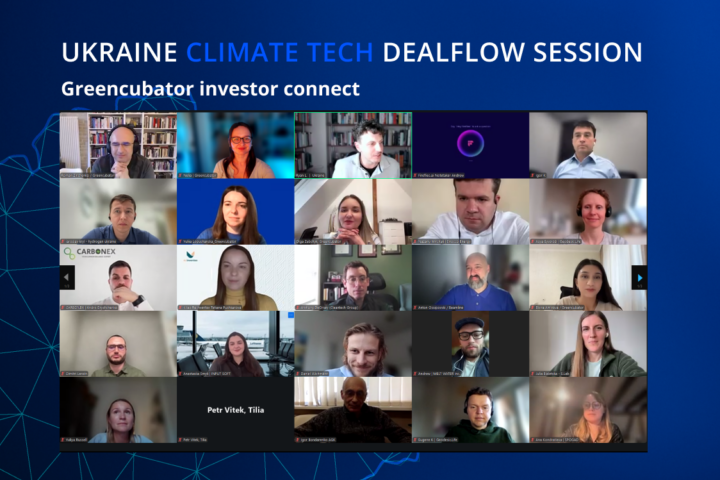
The world is changing, and with it, investor demands for green innovations are transforming. The Ukrainian startup ecosystem is gradually maturing, but it still remains quite young and vulnerable to global storms. To understand exactly where capital is moving right now and how to raise funds in turbulent times, leading investors and founders gathered for a panel discussion during the Demo Day of the educational program “Growing Ukraine’s Green Industries: Capacity Building for Climate Innovators.”
This program is part of the “Climate Innovation Vouchers” project, funded by the EBRD with support from the EU and implemented by Greencubator in partnership with the UCU Business School.
Panel moderator Roman Zinchenko (CEO and Co-founder of Greencubator), together with the guests, analyzed in detail what is currently working in the venture market and where it is no longer worth wasting time.
The Geography of Capital: Between Energy Security and Ecology
Opening the discussion, Roman Zinchenko noted that the attitude toward cleantech today heavily depends on the target market. For example, after a recent conference in the US, it became clear: everything “green” there is currently being intensively repackaged under the guise of energy resilience and security, because with this positioning, it is much easier to sell.
Ivan Petrenko (Managing Partner at Angel One Venture Fund) confirmed this trend: walking around the States with “cleantech” written on your forehead is no longer enough. American capital is currently focused on other priorities – to be of interest, your project should ideally be built on AI or LLM models. Meanwhile, Europe remains more stable: they still consider themselves cleantech-oriented and are ready to provide serious funding. However, European corporate investors are only willing to talk when a startup has all policies in place and fully meets compliance standards.
The Priority of Numbers: Why Impact is Taking a Backseat
This geographical specificity leads to another global shift – pure “impact” is taking a back seat, giving way to clear financial models. Even funds historically focused on ecology now operate with a pragmatic logic: you are making green things – that’s great, but show us your economics.
Dmytro Symovonyk (Investment Advisor at Citadel Capital) noted that Ukrainian angel investors have historically been interested not so much in the impact, but in the opportunity to earn a return. He emphasized that founders must know their unit economics by heart and have truly massive ambitions. If a startup says it wants to become a $10 million company, investors expect to hear a strategy on how to grow it to $100 million and what needs to be done to reach at least $20 million in revenue. Ivan Petrenko added that a basic lack of understanding of one’s own unit economics is one of the primary reasons for rejection.
Sell the Solution to the Problem, Not the Hardware
It is especially difficult for hardware startups to attract funding, as developing and scaling physical products is a long game. Nazarii Mirchuk (CGO at Sirocco Energy) explained that for such projects, commercial piloting with the market and predictable profits are key.
But how exactly should complex technological solutions be pitched? The main advice from experts is to sell the benefit, not the technology. Ivan Petrenko highlighted a crucial rule: an investor is not obliged to understand your technology; they are obliged to understand your business. Instead of overwhelming listeners with the number of kilowatts generated, simply say that your clients saved $500,000 in a month. It is vital to love your client’s problem more than your own product.
The Art of Relationships: Networking, Discipline, and “Warm Intros”
Ultimately, even perfect unit economics and a great product require the right communication channels. On-the-fly elevator pitches at conferences are mostly ineffective nowadays. Sending “cold” emails to a fund’s general inbox is also quite inefficient. Dmytro Symovonyk advises finding connectors and asking for a “warm intro” from startups that have already received funding from that particular fund.
Yelena Artemenko (Co-founder of GO TO-U Ukraine) recalled the mantra of the international accelerator Techstars: “Give first.” This approach means being ready to share information and genuinely build a network with other teams. Furthermore, investors highly value discipline in communication. Nazarii Mirchuk shared his own corporate experience: sending regular updates to investors, even before you raise a round, helps keep them informed, measures their satisfaction with the communication, and systematically builds trust.
Navigating the Future of Cleantech Investment
Ultimately, this panel discussion made one thing abundantly clear: the era of securing venture capital based solely on a compelling “green” mission is over. Today’s investment landscape demands a highly pragmatic approach where environmental impact and profitability must go hand in hand.
For founders navigating these turbulent times, success lies in understanding the specific demands of their target markets, maintaining rigorous financial discipline, and relentlessly focusing on solving real customer problems rather than just building complex hardware.
By combining this strong business acumen with the art of strategic networking and consistent, transparent communication, cleantech startups can not only survive the current market shifts but also attract the capital needed to scale their sustainable solutions globally.


